Translate

Sunday, November 23, 2014

Let's Go Out To The Movies: The Hunger Games: Mockingjay Part 1 (PG-13 - Lionsgate - 2 hrs, 3 mins)

Directed by Francis Lawrence
Written by Peter Craig and Danny Strong

Alo Party Peoples.


Here we go again. This has been a year of growth for me as a critic. I've established a solid foundation for myself and my writing style, gotten a better hold of what does and doesn't appeal to me personally, and found that I'm better at writing these when the subject involves the fantastic for reasons that I'm still not entirely sure of.

I've also found that a certain type of film tends to get under my skin. I speak, of course, of the flood of pandering, cheaply produced dystopic SF laser focused on the wallets of the parents of insecure teenagers, the YA "genre" that have been flooding our theaters for the better part of the New Tens, and bookstores since at least the latter half of the Zeroes. The thing that gets at me about the works filling this particular market niche (I don't refer to it as a genre anymore), is the laziness of so many entries.

Sidenote - The only one I can think of that didn't leave a sour aftertaste in my mind was The Fault In Our Stars, and I only consider that a YA movie because John Green writes for teenagers, and that's where a lot of his fanbase lies. Otherwise it has almost nothing to do with most of its peers. -End Sidenote.

One might think that since I have such disdain for the genre, that I would loath The Hunger Games, since it started the current strain of YA movies, but you'd be wrong. I don't hate this series, in fact I kind of have a respect for it. It's just peachy that a generation growing up in the wake of the Digital Revolution is getting into a big multi-media franchise about the importance of media in people's lives, and it's especially good that young female readers have a better role model to look up to than Bella Swan. However, I was never quite sold on the Hunger Games movies as movies. They aren't bad, but they weren't exactly paragons of cinema. The first two movies played to me as serviceable action flicks banking on the popularity of the books, and the decision to split the series' final installment, Mockingjay, into two parts read to me as little more than following the established tradition of splitting up stories to extend the box office lifespan of a franchise.

For the parents that drew the short stick at the mall and had to take everyone else's kids to see this, or anyone else that isn't particularly invested in the series' lore, the franchise is set in the fictional future dystopia of Panem and concerns an ever escalating war between rich and poor classes as symbolized by the easiest possible visual metaphors for rich and poor classes. The evil oppressive Captiol, modeled after King Louis' court and/or Caligula's Rome, and the good Districts modeled on impoverished and downtrodden Great Depression blue collar workers. The Capitol has kept order for close to a century via a televised blood sport called the "Hunger Games" where the districts sent their children to die for the entertainment of their oppressors, but this started to backfire when series' hero Katniss turned the public opinion machine against them. As Mockingjay Part 1 opens, Katniss has discovered that her surprise escape at the end of the last movie was secretly managed by rebels operating out of a secret former District seeking to overthrow the Capitol.

Because there aren't any more games for Katniss to fight in, the conflict here is psychological. Since she was already mentally scarred twice by one propaganda campaign, can she pull it together long enough to do it again when the propagandists are on her side, and does this by letting them mold her into the Mockingjay symbol that has become an emblem of anti-Capitol sentiment in the Districts. They manage to get a good deal of drama out of that, and Jennifer Lawrence is more than game for the role, and having the production work on the rebel's "propos" staged as a funhouse mirror version of the reality TV-esque production work of the Games in the first two movies is one of the more interesting parts of the series so far. We also get to see the home front for once, which lets the mass media culture/Occupy movement/war coverage stuff that was brushed to the sidelines in prior installments come to the forefront here, which is a welcome change of pace.

Unfortunately, those changes are barely felt since the production has been padded out to the horizon in order to justify splitting the final book into two movies. This could have easily been a 90 minute movie or even a 65 minute TV special, but instead we get to see the assembled cast moping around a bunker for great stretches of time in between the good bits. It's the same problem that always accompanies doing so, part one ends up being all about setup for the more interesting stuff consigned to part two. That isn't Suzanne Colin's fault, not by any means, the blame goes to Lionsgate's corporate overlords that wanted to keep their cash cow pumping cheddar for their stock holders at the expense of the film's overall quality.

That being said, I've liked Mockingjay the movie so far. I don't know that I can recommend it to anyone not already invested in the franchise, but it's a solid action movie and the best part of the series so far.

Have a nice day.

Greg.B

Sunday, November 9, 2014

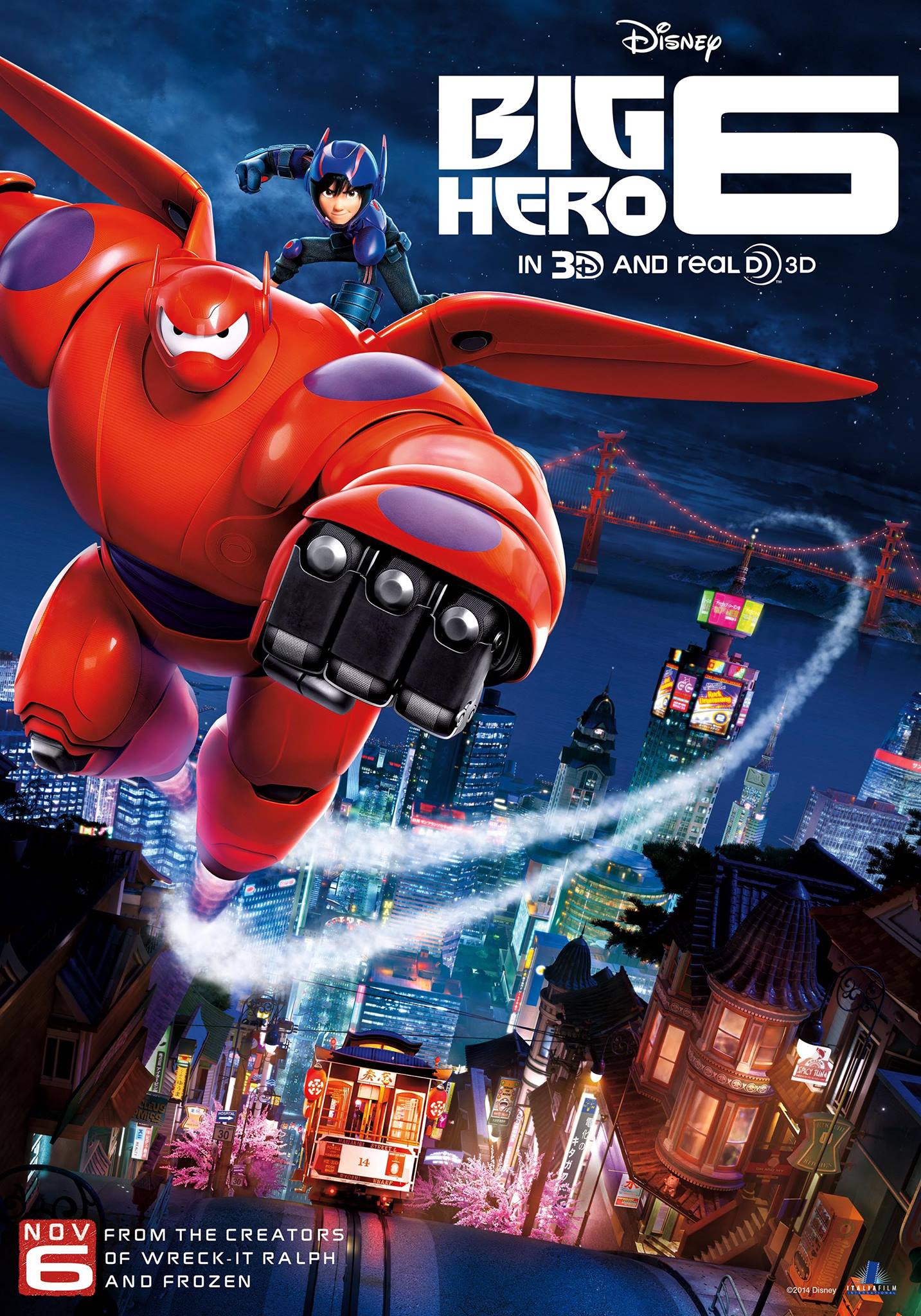
Let's Go Out To The Movies: Big Hero 6 (PG - Disney - 1 hr, 45 mins)

Directed by Don Hall and Chris Williams
Written by Don Hall, Daniel Gerson, and Jordan Roberts
Alo Party Peoples.

This weekend has two very different films competing to win the box office, Interstellar, a hard SF epic drama from Christopher Nolan, and Big Hero 6, an animated family movie from Disney that is also a superhero movie. Aesthetically, they couldn't be more different, but thematically they both share an admiration of science and engineering as a force for good. I'm not going to say which is better, honestly that would probably require a bit of hindsight, but both are fine productions and Big Hero 6 is on par with The Incredibles as a good family superhero adventure.

Big Hero 6 is the first, and probably not last, animated production from Disney to be based on a Marvel Comics property, but its source material is so obscure, and the adaptation more or less just took the title and little else, that it doesn't matter, and Disney has downplayed the connection in marketing.

Our story concerns one Hiro Hamada, a teenage robotics enthusiast living in the futuristic mega city of San Fransokyo, which as it's name would suggest, is what it would look like if San Francisco was designed and built in the Far East, who's fast track to early college is interrupted when his older brother Tadashi dies in a fire at a robotics convention. This sends him into a grieving self seclusion that is pretty heavy stuff for a kids movie.

Hiro suspects that the fire wasn't an accident, but was actually part of a sinister plot by a mysterious super-villain using super science nanomachines stolen from him. He decides to track him down, and to do this he conscripts the aid of Baymax, an inflatable healthcare assistant that he retrofits into a combat bot. Baymax goes along with this because it fits in with its programming to "heal the sick and injured", and Hiro claims that getting revenge will help his emotional state. Also helping, connecting with his brother's friends from college Wasabi, GoGo Tamago, Honey Lemon, and Fred while enlisting them to use their various scientific fields to become the Big Hero 6 of the title and take down the bad guy.

The characters are all fantastic and come across as immensely likable, with the obvious standout being Baymax, and the assembled voice cast does a wonderful job. Ryan Potter finds a line between obnoxious and charming as Hiro, T.J Miller is clearly having a good time playing laid back slacker Fred, Jamie Chung brings real energy into GoGo's tomboy routine, Damon Waynes Jr. fills the role of the neurotic, OCD-ish Wasabi really well to great comic effect, GĂ©nesis Rodriguez brings real life into Honey's familiar nerd girl performance and stops it from becoming a caricature, but the standout is, of course, Scott Asdit as Baymax.

Baymax, besides being a great character design, is a fantastic depiction of how user friendly AI actually functions. There is never any indication of Baymax gaining a soul or becoming more like a human, instead the reason he is so likable, and will probably sell all of the toys, is that his programming is so responsive that people, including the audience, can project humanity onto him.

Unfortunately, they did such a good job setting up these characters, and devoting time to the same, that the film goes by much too quickly. Blame it on the conception that children won't sit through a movie if it runs longer than an hour and a half. The writers clearly felt that Hiro rising out of his grieving was the heart of the movie, and it is, and since being able to ask his friends for help is a big milestone in doing so, by the time that happens the movie is already halfway over. Meaning that the business of putting the team together, establishing their powers, and going after the bad guy - who at first seems easy to guess the identity of but then things go in an unexpected direction - is delegated to the last forty five minutes, which makes those proceedings feel more than a bit rushed.

They're clearly meaning to start a series, and it's winning the box office which means it will, so we'll probably get more of the team interacting in the sequels, but they did such a good job setting up dynamics between them in this movie that I wanted to see a bit more of that, but what's here is more than satisfactory, and once we do get to the superhero business it's all beautifully animated and filled with creative energy.

Big Hero 6 is a damn good superhero movie, animated or otherwise, a fantastic family movie, and another solid entry in what I am now calling the Second Disney Renaissance.

Have a nice day.

Greg.B

Tuesday, November 4, 2014

Let's Go Out To The Movies: Interstellar (PG-13 - Warner Bros./Paramount - 2 hrs, 49 mins)

Directed by Christopher Nolan
Written by Johnathan Nolan
Alo Party Peoples.


This, my readers, is the big one. There were definitely other movies I was looking forward to seeing this year for various reasons. Noah to find out if applying the trappings of mythic fantasy to scripture was a valid approach (kind of, depending on perspective), Lucy to see what a 21st' century take on the ideas and themes of The Matrix would look like (we didn't get that), The Fault In Our Stars to see whether the work of John Green adapted to the silver screen (it does), but no film's marketing campaign attracted my attention quite like that of Interstellar.

It started long before any real footage was available. When I saw that first teaser, the one that was mostly Matthew McCaughnahey giving a speech over stock footage of NASA missions, it stuck in my mind more than anything else I could think of. I still have that speech memorized, and knew that I would have to see this, even before I started taking this site very seriously. I even sought out and purchased tickets to an advance screening on 70 mm film.


It's forty-odd years in the future, an incredibly virulent disease and environmental collapse are killing all of our crops and livestock, creating a worldwide Dust Bowl effect and slowly killing the planet. Our focus is on Matthew McCaughnahey as Cooper, a retired pilot and engineer that deeply resents the steps mankind has taken to make what time we have left livable. Coop, like me, is a bit of a space nut, and he is furious that those aforementioned steps included scrapping any sort of scientific experimentation or exploration, to the point that schools teach children that the Moon landings were faked to fool the Soviets into spending money on "rockets and other useless machines".

One night, during one of the all too frequent storms, Coop discovers mysterious phenomenon occurring in his young daughter Murph's bedroom, which lead him to the remains of NASA, literally forced underground when public opinion turned vehemently against "spending money on space exploration when people are struggling to get food on their plates". They've found a couple of things. 1) the virus killing all our food is making the atmosphere un-breathable,  and 2) a wormhole out near Saturn that could lead to habitable new homes for humanity.

Coop signs up to fly the spaceship, and most of the movie is spent on that journey to see what's on the other side, and that's where Interstellar, well, shines brightest. The creative team, including theoretical physicist Kip Thorne, has done a good job sticking as closely to hard science as a story about rocketing off through mysterious portals to unexplored alien worlds can. Depicting wormholes, black holes, and even higher spatial dimensions as close to what we imagine they would work and look like. He even makes relativity of time into a plot point, setting a scene on a planet where the higher gravity means that hours there are years in Earth time.

They also do a really good job establishing a feeling of scarcity, both on Earth, which drips with constant Depression working class misery, and out in space, where that scarcity is lack of other humans. Matt does a wonderful job expressing that, perfectly encapsulating the feeling of being unimaginably far from everything and everyone that he's ever known or cared about. Of course, it isn't a one man show, Anne Hathaway and David Gyasi as fellow astronauts play off each other really well, Bill Irwin as the ship's automated assistant TARS comes off as consistently amusing, and only sometimes feels like a relic of when this was going to be a Steven Spielberg movie.

Unfortunately, that aforementioned feeling of isolation keeps being interrupted when we cut back to Earth during Act 3, where we see Jessica Chastain as a grown up Murph working for the secret NASA enclave. Oh, don't get me wrong, she's great in the part, but if Coop gains audience sympathy because of how alone he feels, and how uncertain he is of whether there are any people left on Earth left to save, that is undermined when we see that there are in fact people left that are still trying to save themselves, and the climax dealing with concepts of love as a quantifiable force that reaches across dimensions, while executed competently, have more than a little dissonance between the script written for master of heart string pulling Spielberg, and Nolan's much more stoic cinematic sensibilities.

That being said, Interstellar is still an impressive feat. An ambitious project in a year full of ambitious projects, it is a compelling hard SF drama paired with a stunning 70 mm IMAX show reel of fantastic cinematography. All paired to a pounding, tension building Hans Zimmer score, although there appear to have been some sound engineering issues since that score occasionally drowns out dialogue. Anyways, I think it's a damn good movie, it's almost certainly ending up on my best of the year list, and I'd recommend seeing it.

Have a nice day.

Greg.B

Sunday, October 19, 2014

Let's Go Out To The Movies: The Book of Life (PG - 20th Century Fox/ Reel FX - 1hr, 35 mins)

Alo Party Peoples.
The Book of Life (2014) Poster
Directed by Jorge R. Gutierrez
Written by Jorge R. Gutierrez and
Douglas Landale

Today's subject was apparently being passed around to various studios since at least 2007. It was turned down multiple times for one of two reasons. Either the studio wanted to mess with Jorge R. Gutierrez's artistic vision, or they objected to so many characters being Mexican, and The Book of Life is, at least in an aesthetic sense, distinctly south of the Rio Grande. In fact, that it got released at all speaks to the idea that the Hispanic movie going audience is now large enough to aim a production specifically at them.

Our story is the tale of three children in San Angel, the "town at the center of Mexico". The soft hearted Manolo, who comes from a family of bull fighters but has always wished to be a musician, the courageous and arrogant Jouaquin, the son of a late general who died defending the town from bandits, and the rambunctious Maria, the shared object of their affection.

Their little love triangle draws the attention of this world's two rulers of the afterlife. The saintly La Muerte, who rules over the neon infused, Day of the Dead celebration inspired Land of the Remembered, and the devious Xibalba, who rules over the limbo-land of lost souls that is the Land of the Forgotten. The two ended up with their domains in a bet, and Xibalba has grown discontent with his dreary lot in life. So he proposes another bet over which of the boys will marry Maria, the winner gets the other's domain forever. La Muerte chooses Manolo, Xibalba chooses Jouaquin, and the latter cheats by giving his chosen pawn an enchanted medal that protects him from physical harm.

Cut to years later, when Manolo has followed in his father's footsteps and become a bullfighter, Jouaquin has used his invincibility to become the hero of the town guard. Maria has just come back from studying in Spain, and their love triangle sparks back to life. The boys spend the day fighting each other over Maria's affections, and by the end of the day Manolo seems to have won out, but Maria is bitten by a snake and lies seemingly dead. That's when Xibalba approaches him with a proposition, he can reunite the two. He accepts, and is bitten by the snake twice and dies for real. After this, Manolo discovers that Maria was just in a coma, and Jouaquin's medal has brought her out of it, where she finds that if she doesn't marry Jouaquin, he will leave San Angel, leaving it at the mercy of the bandit king Chakal. Now Manolo must go on a quest to find La Muerte in the land of the forgotten so he can return to the world of the living and save the town.

That's a lot of backstory to get out, and the solution Gutierrez finds is to structure the film in the same style as The Princess Bride, in the sense that the story is being told by a museum tour guide to a bunch of grade school students, where she can act as an omniscient narrator explaining the film's cosmology.

This particular aesthetic isn't for everyone, but it looks gorgeous. The character models resemble wooden puppets, and intentionally so unlike some other productions. The production studio attached, Reel FX, is based in Dallas, and this is their second big animated production. Occasionally it's budget of only 50 million shows through, but most people won't catch the few hiccups present, because they will be distracted by the stylized, distinctly detailed woodcarving appearance of the characters and the world they inhabit.

Unfortunately, the script had nowhere near the same amount of attention to detail put toward it. It comes off as entirely conventional, if you've seen one children's fantasy adventure before, you will be able to guess the story beats more or less consistently throughout. Then again, this wasn't made for critics, it was made for children, and this will certainly keep them entertained.

The Book of Life is a beautiful looking, slightly above average children's movie, that forgoes substance for style and is only worth seeing in theaters for animation buffs and parents who want their kids to have a good time that night.

Have a nice day.

Greg.B

Saturday, October 18, 2014

Let's Talk About Movies: Life of Brian and The Gospel

Alo Party Peoples.

I just watched Monty Python's Life of Brian, a movie about the titular man being mistaken for a godsend. It is also set in Judea during the time of Christ. Just depicting the story of Christ in the context of a comedy would be enough to outrage, and thirty-nine local authorities in the UK did in fact ban the film, but it goes further than that. The actual Jesus shows up near the end, as a pedestrian witnessing criminals being marched off to be crucified. He offers to take the burden of one of the prisoners, who immediately flees the scene, the Roman officers assume him to be one of the prisoners, and take him off to be crucified. Jesus then says "I didn't realize I had to go through all of it." and tries to flee from his fate. They are implying that Christ was just some common do-good-er that got in way over his head.

It isn't just that, at no point is the presence of God ever explicitly depicted. That might be bad enough for some people, but consider this. There is a homeless beggar that claims to have been cured of leprosy by Jesus, but the audience never sees that happen and thus cannot know whether he is telling the truth. If he is telling the truth, then the filmmakers are implying that Jesus ruined someone's livelihood by ridding them of a disease that people took pity on him for and thus gave him money, and he's also an ungrateful jerk that took advantage of Christ's divine charity and had the gall to complain about it afterwards. If he isn't telling the truth, then he's committing blasphemy and, albeit failing, taking advantage of people's sincerely held religious beliefs for his financial gain. He took his blessings, and thought they weren't good enough.

During the Sermon on the Mount, the words "blessed are the peacemakers" are misheard by people in the back as "blessed are the cheese makers", the characters then go on to debate whether that was meant literally, or as a blanket term for all dairy workers, or as something else entirely. On its face, that might be relatively harmless, but ponder this.

My father discussed this film and what its subject at length just before I started writing this, and he interprets "peacemaker" as someone that helps people find a common ground, but others might define peace as stability. Thus those that bring and maintain stability are blessed, and the Roman Empire is often seen as having brought safe travel and commerce to all of the Mediterranean world, thus they would be blessed. Add to that, that the Romans at this time saw ideas like those preached by Jesus, and the local religious establishment for that matter, with their assertion that worldly authority is less important than salvation, as a dangerous threat to stability in Judea. Thus, under that interpretation of "peacemaker", the Romans are blessed and Jesus is damned. While discussing initial drafts with my father, he said I was missing the point, and that the characters were also missing the point of "peacemakers

The thing is, as my father put it, the movie isn't making fun of Christianity itself, it's making fun of the insane things that people have done in the name of Christianity, or misinterpreting good ideas for their own ends. As an example, partway through the film, Brian has attracted quite the following of people who think he is the Messiah, he doesn't want this position, and is literally shunning it by fleeing from them. While running he inadvertently drops a gourd and a shoe. One of his followers picks up the gourd and proclaims it to be a sign. Then another one finds the shoe and thinks that's a sign as well, and thus they think that everyone should take off a shoe for their Messiah. If they were depicting the sale of indulgences or 16th century witch trials, you could argue that they are mocking faith, but they made the decision to stay away from actual events, and stick to stuff they made up.

Was the arguable blasphemy intentional, it probably was. The Python troupe did share a distrust of organized religion, and they clearly thought the material is fit for comedy, in the same way that they thought Arthurian lore was worth making fun of in Holy Grail. But, during early brainstorming sessions for the Life of Brian, they found that they didn't object to any of Christ's teachings, and couldn't find anything to mock about them. That's probably why the focus isn't on Christ himself, and is instead on someone mistaken for Christ that isn't preaching. The persons actually being made fun of are those that take the ideas at the heart of a religion, and use them for their own ends, like the Preachers of the Gourd and the Shoe, or the Catholic Church selling indulgences , or the courts in Salem hanging radicals under the pretense of punishing witchcraft i.e. organizers of religion.

Of course, Life of Brian isn't the only film to criticize faith, or this particular one. Would it surprise you to find that some people think Pleasantville advocates sin? I've already talked about Pleasantville at length, and this is already a long post, so if you've never heard of that movie, read this. Anyways, that movie is commonly interpreted as an allegory for the Garden of Eden, and the man behind that film definitely drew on imagery from Genesis when making it. However, again while discussing this with my father, he argued that the town of Pleasantville wasn't really Eden because it is clearly not paradise. The conformity of the town is not portrayed as a good thing, and it's even shown as soul crushing and, after a while, something akin to torture.

Now I turn things over to my father. Who, when asked if he would write a response to this, wanted to know if that could be an addition to this article. I told him yes. After the end of this paragraph, everything you read will have been written by him. I think he's a smart guy, and we often discuss the subjects of this blog before and after I write about them. Without further ado...

Hey y'all ... wow, what an opportunity. Us parentals often look at our kids and wonder about how things would have been different if we had known what we know now at their age, and desperately desire to communicate our hard earned understanding so they can benefit without paying the price that we did. While watching Life of Brian with my kids was both an opportunity and a risk, I'm betting it will be a bridge for communication and growth well worth the risk.

As Greg mentioned, Life of Brian was widely banned by the religious institutions it satirizes. Monty Python's gig in all things is exaggerating the absurd and ridiculous, and the fact is Christian history and religious institutions (as opposed to personal faith in Christ) has given them way too much material to work with. When my friends and I saw Life of Brian as teenagers it summed up so much of what bothered us in the religiosity we saw around us. Classmates in Church rejecting alcohol/drugs/promiscuity on Sunday but drunk/high/sex-ing on Friday. Out of context scripture and better-than-you hypocrisy fully worthy of parody, ridicule, and rejection. What we saw was real,but there is more to the story.

"Blessed are the cheese makers" mishears, misinterprets, and misapplies the message, and that's the point. While some mishear, misinterpret, and misapply Christ for their own benefit, "blessed are the peacemakers" calls those who follow Christ to be peace makers. The crowd following after the Messiah's gourd or the Messiah's shoe or following after some "thing" are not following after the Messiah, and that's the point. Following after a cross or a church or a preacher is not the same as following after Christ, and following after Christ is life.

By processing through Life of Brian together I hoped to help my kids understand and see through a whole lot of crap and come closer to saving faith in Christ.

(BTW and FWIW, while Life of Brian hardly mentions God or Jesus directly, in one scene it does misrepresent Jesus as an oblivious do-gooder looking to briefly shoulder the burden of a crucifyee  but not really willing to pay the ultimate price. As always, this was a teachable moment Romans 8:28.)

..... and I'm back. As you might have guessed, my father is a confident follower of Christ. This has caused much discussion between us over the years because, as you might have guessed, I am not a very religious person. Unlike those following the Preachers of the Shoe and Gourd, my father did not just go into Christianity blind. He spent decades contemplating the issue, and only when he experienced something that went beyond reason or logic, did he commit. In his words, "knock [on God's door] and the door will open", that if you look for it, revelation will come to you.

Have a nice day.

Greg and Vince B.

Monday, October 13, 2014

Let's Go Out To The Movies: The Judge (R - Warner Bros. - 2 hrs, 21mins)

The Judge (2014) Poster
Directed by David Dobkin
Written by Nick Schenk, David Dobkin,
and Bill Dubuque
Alo Party Peoples.

We made it. It was a long, slow, tedious September, but we've finally reached prestige season. The kids are back in school, the leaves are falling, the weather is getting colder, and theaters are now being graced with serious contemporary dramas, lower scale genre material, some family movies on lucrative holiday weekends, and in general productions hoping to snag an Academy Award.

The Judge is a courtroom drama Robert Downey Jr as one Hank Palmer, a big city defense attorney known for getting guilty clients off the hook. One day, during a trial, he receives a phone call informing him that his mother has died, and heads to the funeral in a small town in the Indiana backcountry, one that he describes as a "Bible Belt backwater". There he sees his father, the judge of the title, and discovers that he isn't well thought of there. After a ruling, his father is implicated in a murder trial when a man he sentenced some years ago is found dead in a ditch. Hank decides, out of the goodness of his heart, to help him by defending him in court.

The cast is damn good. Downey is damn good in this, presenting a man that has definitely drifted from his roots, and a good chunk of the drama comes from just how much he's changed and how much the town hasn't. Robert Duvall as the judge of the title is good, Vera Farigma as his old flame is good, I just wish there was a script there that was worthy of the caliber of the performances.

Not that I think The Judge is a bad movie, it's not. It's well shot, really well acted, there aren't any plot holes to discuss, but it's entirely relying on pathos and there isn't much in the way of a message it wishes to impart, or themes to explore, it's like air, I guess. I don't know why, but stuff like this tends to be difficult for me to talk about.

The Judge isn't a movie that will change anyone's life, but it's a damn good one, and when it ends up being circulated on cable, it will make fine Saturday afternoon background noise.

Have a nice day.

Greg.B


Saturday, October 4, 2014

Let's Talk About Theatre: Vunderland (PG-13 - RHS Theatre - Variable Length)

Alo Party Peoples.
Directed by Erik Archilla
Written by Cleft McClelland


As some of you may know, I'm currently attending school. What you didn't know is that I am part of the theatre department, which is currently putting on their Fall production, Vunderland. I am also required to see at least one live theatre performance a year, so I figured I'd get an article out of it.

Vunderland starts out as a straight adaptation of Alice in Wonderland, but it soon becomes something both different and unique, starting by moving the stories' time period from the mid-19th Century to the middle of the 1930s'. When Alice falls down the rabbit hole, the story starts to diverge from the form it usually takes. She sees that the boundaries of Wonderland have started to break down, and thus begins encountering characters from other works of classic literature. She encounters the pirate Long John Silver in search of a treasure, a bunch of animal men created by a doctor who's name begins with an 'M', and falls in love with a Stranger that, while I'm sure his identity was supposed to be a big reveal, those familiar with his source material will figure it out almost immediately.

Once they get to the Queen of Hearts' garden, things get explicit. The Queen fears the changes that have been occurring in Wonderland as the borders between worlds burn away, so she starts taking on the attributes and policies of the reason the borders have been burning. Namely, the Nazis during the buildup to World War 2.

The assembled cast is terrific, especially for a bunch of high school students. One Molly Harrison as Alice puts on a fine accent, one Zeara Seaman as a Cheshire Cat who is now a veteran of the Great War sells the madness of both the character and the Great War, one Killian Ellis as the Stranger's intentionally monotone speech is entertaining, but the standout is unarguably Chloe Clark-Soles as the Queen of Hearts. She has a compelling, dominating onstage presence, and as a four year member of the Theatre department, I can see this kid going places in ten or fifteen years. Either in more theatre, or perhaps one of those moving picture shows that this site normally focuses on.

I can praise the performances as much as I like, but ultimately that won't matter to potential viewers. By its very nature, a stage play, whether because of different actors, aesthetic choices, or just technical goofs, will be different every time it is performed. The only constant between any two productions will be what's in the script, and Vunderland has an excellent one. A script about the power and longevity of ideas, and how the times when they are challenged are often when they become the most powerful.

Vunderland is a fantastic production with good performers, and a thoughtful script, that most of you won't have the chance to see. Since this is a small, local thing, it's very unlikely that people outside of the Dallas, TX area will ever be able to experience it, and fifteen years ago wouldn't even be able to know about. It might thus seem odd for me to bring it up here, but I think that if I do, it slightly raises the potential that the school board might do something with the script after it's initial run.

Have a nice day.

Greg.B