Translate

Tuesday, June 28, 2016

Let's Go Out To The Movies: "Independence Day: Resurgence": A Pale Imitation

Directed by Roland Emmerich
Written by Roland Emmerich,
 Nicholas Wright, James. A Woods,
Dean Devlin, and James Vanderbilt
(PG-13 - 20th Century Fox - 2 hrs, 0 mins) 

Alo Party Peoples.

"Sparky sparky boom, man."

That is the experience of watching Independence Day: Resurgence. It's not exciting, it's not even interesting in its failure, it just happens, and then it's over. The story that exists is little more than a retread of the already intentionally arch original, all the easier for whoever has to dub it into Mandarin. It's all the glossy explosions for glossy explosions' sake that director Roland Emmerich's detractors go after him for. Granted, they're really good looking, well shot glossy explosions, Roland Emmerich is a flat out better technical filmmaker than most other blockbuster specialists. But it's glossy explosions all the same, and without the sense of earnest effort or heart that make his good films work and his bad films uniquely memorable.

And it's not like I was expecting high art from Resurgence either; despite what some of y'all might think, I've got nothing against glossy explosions. Fury Road got onto my best list last year, and pretty damn high, too. The Marvel films are one of the few things that I'll go out of my way to see regardless of whether they've been screened for critics. Hell, I even kind of liked Hardcore Henry, and it's about as glossy as glossy gets. But in those cases, the glossy explosions are complimented by something more; Fury Road is packed to the gills with crazy car stunts, but it's also a serious epic with actual observations about social dynamics and personal autonomy and an introduction to feminist theory, while still being packed to the gills with crazy car stunts. The Marvel movies get cited for "superhero fatigue" all the time by "serious" critics, but they do their antics in service of dynamic characters. Even Hardcore Henry occasionally struck a thematic line of feeling that someone else is pulling your strings.

And Independence Day is sort of like that too. The glossy explosions are definitely a focus, but even though we can be assured that billions of people are dying, human carnage isn't what Emmerich chooses to turn the camera too. Instead, it focuses on the destruction of buildings, landmarks and iconography. Those iconic shots of the Empire State Building and the White House being blown up aren't just eye candy for the trailers; by showing the destruction of all the symbols and borders we put up between eachother, and then showing mankind rising from the ashes to defeat the invaders, it establishes a theme. That at the core of the film, Independence Day believes that our differences hold us back, and the aliens almost did us a favor by blowing apart the divides we'd put between us, because it allows us to harness the strength that comes from unifying. It's that kind of optimism in the face of the literal end of the world that's turned Independence Day into a generational touchstone for Millennials. An accidental time capsule of how optimistic and forward looking the Nineties look in retrospect, especially compared to today's blockbuster landscape where even Superman has to be grim and morose all the time.

Roland Emmerich is not a subtle filmmaker, anyone that saw The Day After Tomorrow or White House Down can tell you that, so with the context of Independence Day's place in the popular culture in mind, making a sequel in a post-9/11 zeitgeist should allow it to burst with meaning, intentional or not. That first trailer, with its super serious title card intoning "We always knew they would come back." seemed to hint at something. Maybe the feeling here would be "paranoia after a devastating attack leading to constant military buildup in preparation for a second assault that may never come", that'd fit as a thematic followup to the original. If there's one reason that a sequel to Independence Day could be even remotely interesting, it's seeing what the post-invasion world eventually became. But Resurgence can't be bothered to wait more than ten minutes before the aliens show up again. Rather than letting us get to know about the setting it's created, and I'll give them credit for not trying to recreate the present, our minds are left to wander amid the fireworks. And I couldn't help but wonder how, despite twenty years passing and civilization being remade with their technology, we never bothered to give the aliens a proper name.

And if the fireworks were good, I might give them some slack for it, but Independence Day: Resurgence is one of the most underwhelming blockbusters in recent memory. The cinematography and effects are all fine, but the editing is horrible, never letting us hold on a shot long enough for it to stick, it's clear that they needed to trim it down for time, because nobody gets an arc or a personality that would let us care about who's doing the shooting. Fireworks are always better when they're actually celebrating something.

If Independence Day is the urtext of the modern blockbuster, then Resurgence is a pale imitation of the same. Where the former can thrill and entertain and inspire, the latter can only waste time. Part of the reason this review took so long is because of how surprisingly hollow this film is. Roland Emmerich at least usually leaves an impression, and it's sad to see him apparently stop trying.

Have a nice day,

Greg.B

FINAL RATING: 2/5

Saturday, June 18, 2016

Let's Go Out To The Movies: "Finding Dory": A Great Family Film, But Not A Great Pixar Film

Directed by Andrew Stanton
and Angus Maclane
Written by Andrew Stanton, Victoria Strouse,
and Bob Peterson
(PG - Disney, 1 hr, 54 mins) 

Alo Party Peoples.

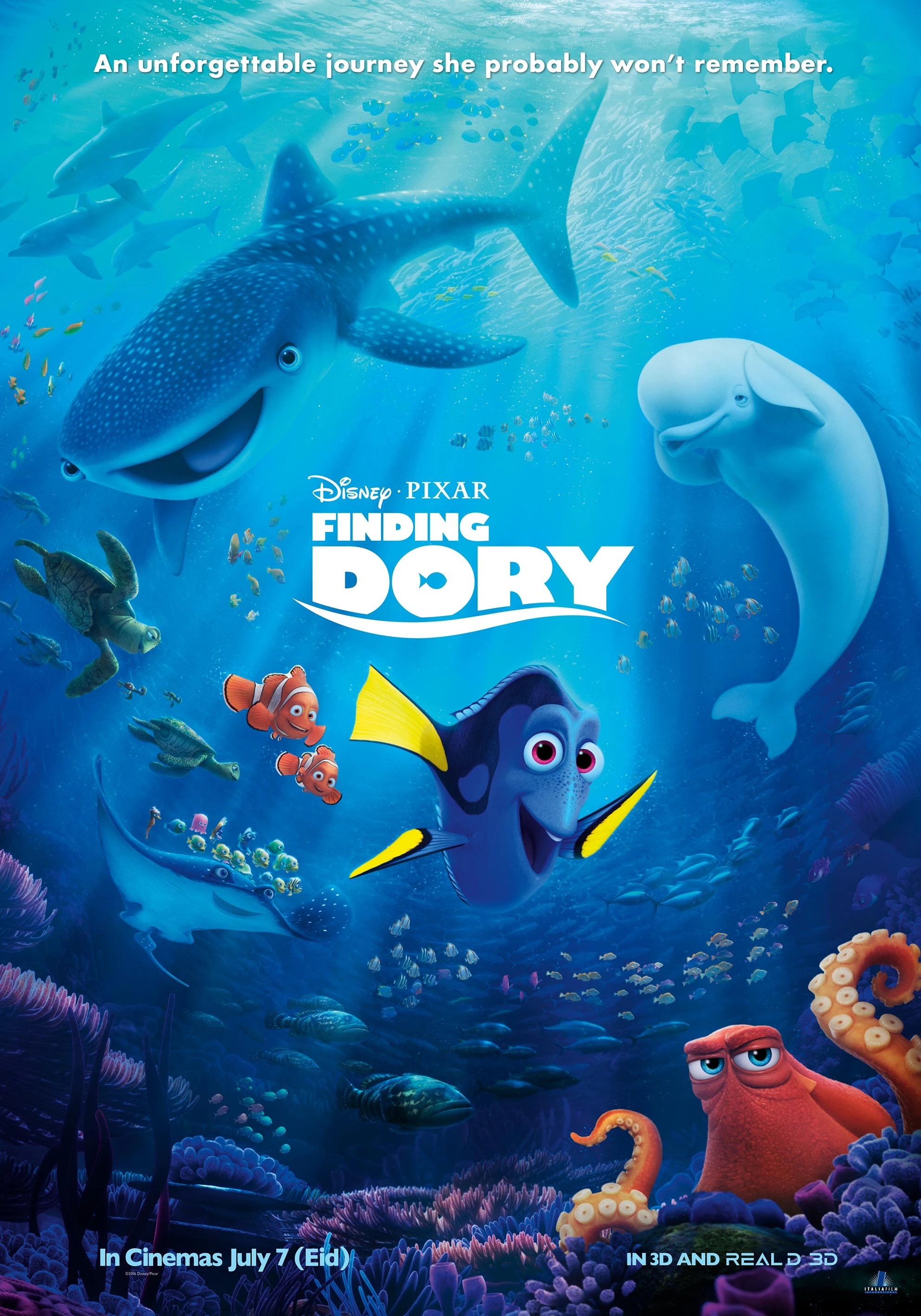
Finding Dory is unique in Pixar's catalog in that it has the chance to get really, incredibly bleak towards the end... and then it just doesn't. The studio is already well known for baking heavy emotional gut-punches into material that looks light and gentle on the surface; like a fantasy about toys coming to life that's also about coming to terms with mortality, or a superhero adventure that's also about midlife crises, or a rehash of Herman's Head that's explicitly about how bottling up difficult emotions will only cause them to boil over in the end.

Finding Nemo followed that template in that it's a movie about talking fish, but it's also at least partially about living with a disability, i.e. Nemo's little fin and Marlin's overprotective nature in regards to it being the thing that kicks off the plot and what lends the story most of it's emotional weight. Finding Dory makes it more explicit by revealing that the title character's forgetfulness is actually the result of chronic short-term memory loss, a childhood disability of her very own. The film opens with her parents teaching her coping mechanisms so she can lead a fuller life when she gets separated from them, and wanders the ocean for years, sometimes even forgetting what she's searching for, until the runs into Marlin and Finding Nemo happens. A year later, Dory has an encounter with a stingray triggers a dormant memory, which leads her to drag Marlin and Nemo along on another journey across the ocean to find her parents, which leads them to the Marine Life Institute of California where they get separated again.

"Hey kids/older teenagers that were in grade school when Finding Nemo came out! Remember the funny comic relief sidekick from last time? Well, the forgetfulness you spent the last film laughing at is actually a crippling disability she's been dealing with her entire life!" should come across as self-parody - just writing it out makes it sound like someone's screwed-up fanfiction. But I'll be damned if it doesn't work, because Pixar is that good at this material and because of Ellen DeGeneres' performance as Dory. Making her the main character means she doesn't get to be as funny, but she gets to go deeper and more poignant than Finding Nemo could ever let her be. By the end, it gets damn close to one of the most effecting endings Pixar has ever achieved...

...but then it sort of doesn't. I understand why, if the film ever slowed down enough for the weight of the scenario to really sink in, it'd come across as existentially horrifying instead of just exciting. The characters find themselves literally flung from one life-or-death situation to the next in a mostly dry, human-built space that's far more difficult to navigate than the open ocean. It's the kind of tossing around that usually gets reserved for Woody and company in the Toy Story movies, except that a fish is far less durable than an action figure. Aside from one scene in an interactive tidal pool, it never quite gets to the kind of intensity that Pixar is known for. At the end of the day, it's a kids movie, and you're not supposed to leave deep psychological scars in a kids movie; regardless of how well it would have fit thematically, Woody and company were never going to die at the end of Toy Story 3. Instead it keeps things going along at a good clip, introducing lots of new characters, Ed O'Niell as a curmudgeonly octopus is a real stand-out, and keeping from getting in too deep.

Finding Dory is a great family film, and one I imagine that parents of disabled children will have been waiting for for a long time, but it's not a great Pixar film. All the pieces are there, and if better assembled they could have achieved greatness, but for as long as it took to get a sequel off the ground, Finding Dory simply doesn't clear the bar that Pixar has set for itself.

Have a nice day,

Greg.B

FINAL RATING: 3/5

Sunday, June 12, 2016

Let's Go Out To The Movies: "Warcraft": Skip It Like A Cutscene

Directed by Duncan Jones
Written by Duncan Jones, Charles Leavitt,
and Chris Metzen
(PG-13 - Universal - 2 hrs, 3 mins)

Alo Party Peoples.

It can be an enjoyable thing to watch a bad movie fail. To use the most recent example, seeing every short-sighted overly serious grim-n'-gritty decision made with comic book superheroes since the Nineties come home to roost in Batman v Superman was nothing short of cathartic. And there are entire communities built around cult failures like The Room or Birdemic - hell, even Howard the Duck has it's defenders. And there are people that built entire careers around mocking these sorts of failures like Mystery Science Theater 3000 or the folks at Channel Awesome and its ilk.

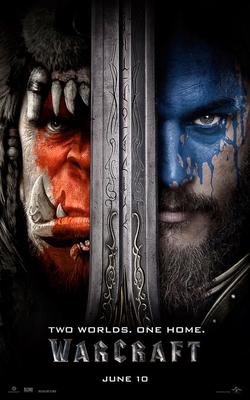
But no such joys are to be found in Warcraft; too ambitious to be written off as fluff and too serious to be called a farce, it is a tragedy. It's like driving past a car crash caused by drunk newlyweds, it's sad because you can tell that the reason it went wrong was because the people involved were giving it their all in hopes of a brighter future. The devotion from director Duncan Jones that lets all the sets and the armor and the weapons and the magic and the creatures feel cinematically real and aesthetically interesting is the same devotion that smothers the rest of the production and renders it an unwatchable slog. He's clearly a big fan of the Warcraft games, big enough that he thinks that the audience needs to know all of the lore and backstory and proper nouns before they can get to any actual plot. He's made an entire movie out of the stuff that the Lord of the Rings movies wisely confined to the first two minutes so they could get to an actual story - even Tolkien kept most of the more trivial worldbuilding details in the appendix.

The result is a masturbatory deluge of the same pop-fantasy milange that film and television and literature and, yes, games drew from Dungeons and Dragons until the "Hey, this could all almost exist" naturalism of Lord of the Rings took over, played so relentlessly serious that it sucks any and all joy out of the gloriously goofy art design. Sure, that's all World of Warcraft ever was on a story level, but without the ability to interact with it there isn't enough of a story or characters there to engage the audience. Great stories tend to have defined characters at their core, a Gilgamesh or a Hercules or a Sun Wu Kong or a Jesus of Nazareth or a King Arthur or a Hamlet or a Sherlock Holmes or a Huck Finn or a Jay Gatsby or a Holden Caulfield or a Clark Kent or a Frodo Baggins or a Luke Skywalker or a Forrest Gump... you get the idea. They all have defined personalities and motivations and arcs, and that's what let them get ingrained in the popular consciousness. A blank homunculus waiting for the character creation engine to decide their entire being is the exact opposite of that. No school will ever assign even the best Choose Your Own Adventure book to be read by its students. I was bored after two minutes, getting antsy after ten, and by the hour and a half mark I wanted nothing more than to be able to push the Y-button in order to make someone do something interesting.

That kind of dissonance is what's really sad about Warcraft, a movie that walks and talks and acts like it sprung fully formed from the collective dreams of a generation of fantasy fandom shouldn't be able to be this dull. There's surprsingly little warcraft in Warcraft, and even when it does happen it looks like a really expensive Scandinavian heavy metal music video, it's flatly directed and the editing is stale and it rarely gets to happen because the filmmakers were more concerned that we might not get that the magic green vapor that comes from stealing souls from prisoners of war and turns anyone that uses it into a horrific wraith is bad.

The experience of watching Warcraft is like listening to that one friend of yours drone on about the Dungeons and Dragons campaign they hosted last week, you can tell that they're really enthusiastic about it, and you feel compelled to keep listening to be polite, but you have no idea what they're talking about and you wish you could just walk away and join the more interesting conversation about that new song on the radio going on across the room. After decades of video game movies sucking because studios chose stuff that was the interactive version of a movie, or because they stripped away all the offbeat, uniquely video-gamey stuff that made it worth translating to film to begin with, or because they just didn't care, now we have one that sucks because the people involved tried way, way too hard to translate everything to the screen, regardless of whether it made an interesting film. It's a cutscene, and the reason you're able to skip cutscenes in games is so that if you just beat the big boss and you're in the zone and you can't wait to keep going, you can get past the boring short film quickly and get back to the action. Warcraft is that, and I suggest you skip it as such.

Have a nice day,

Greg.B

FINAL RATING: 2/5
Wednesday, June 1, 2016

Let's Go Out To The Movies: "X-Men: Apocalypse": It's Time To Let Go

X-Men: Apocalypse Poster
Directed by Bryan Singer
Written by Bryan Singer, Simon Kinberg,
Michael Dougherty, and Dan Harris
(PG-`13 - 20th Century Fox - 2 hrs, 24 mins) 

Alo Party Peoples.

Once upon a time, there were no superhero movies. That's not entirely true; once in a while you got movies based on larger-than-comics pop icons like Superman or Batman, but for the most part it was rare that any character created after the 1940s would get consideration from Hollywood, and even when they did, it was still up in the air whether you'd get a pretty good The Crow, or an abject failure like Howard The Duck or Steel. So when the first X-Men movie came out, and it wasn't terrible, it felt like a revelation, and alongside Peter Jackson pulling off Lord of the Rings and Sam Rami pulling off Spider-Man it was part of the rise of the modern "geek culture" dominated blockbuster landscape.

Then the second one came out and it was quite a bit better, so it got to be called great, but with hindsight they just aren't that good. Parts of them hold up; it was awesome to get two really classy respected British actors to play Professor X and Magneto, Hugh Jackman was such a perfect fit for Wolverine that people still don't want to see him in any other kind of movie, focusing on the gay youth metaphor was a timely update of the material - the first two X-Men films have a deserved place in pop history, is what I'm saying. But nearly everything else to come out of this series* has been either mediocre or flat-out terrible. The Last Stand managed to be interchangeable even by the standards of a Brett Rattner film, X-Men Origins: Wolverine was so terrible that they pretend it didn't happen, Days of Future Past  is a slog that takes a hatchet job to the already fragile semblance of continuity. I get that nostalgia is a powerful thing, I know I've felt an irrational desire to rewind the world and freeze it around 2005 more than once, but I'm not forcing my bubble onto everyone else. I understand why we hold onto this series, but it's time to let go.

But thanks to Deadpool, which not incidentally builds much of its comedy around mocking the anachronistic nature of this franchise, we're going to keep getting more of these and Fox is going to keep jogging in place until Disney offers them a shared custody deal like Sony got with Spider-Man. So it's fitting that Apocalypse is trying to emulate the superficial trappings of a Marvel movie (loads and loads of characters and banter, fanservice-y cameos, jokey references to the comics and other movies, a technicolor palleted CGI apocalyptic finale), but without any of the character work or genuine heart that makes it work. The best example of that is when, in the middle of the inciting incident for Act Two, when all the world's nuclear weapons are being launched, and it looks like the world is ending, they cut to Stan Lee looking up at the rockets. If there's one thing that it should be easy to not screw up, it's putting the funny celebrity cameo in the middle of the end of the world.

Not that the story they came up is that great to begin with. An ancient Mutant named Apocalypse that used to rule Ancient Egypt gets brought back from the dead in 1983 by the time-travel shenanigans in Days of Future Past and decides that he doesn't like what humans have done with the world in his absence. So he decides that he needs to take over the world and the X-Men unite to stop him. That's it. Nobody has an arc, nobody learns anything, the only meaningful change to the status quo of the series is that it provides an explanation of why Professor X went bald early. None of the cast appears to care about anything happening onscreen, Jennifer Lawrence is somehow more disinterested than she was in Days of Future Past, when she started to regret having signed onto this series before she had The Hunger Games clout to bargain with, and she's sadly resigned to being here now that that ship has sailed. Oscar Issac as Apocalypse - good Lord Oscar Issac as Apocalypse; this man is one of the best actors of his generation, and they've put him in six layers of heavy latex makeup and having him stomp around like he got lost on the way to the set of the Power Rangers reboot.

I might have excused that if it could at least be an enjoyable action film, but it's really not. Bryan Singer was never great at large-scale action to begin with, and it's really kind of amazing just how bad all the "big" moments in Apocalypse look. Limp lifeless effects and flat cinematography make the entire production look like a bunch of Abercrombie models in decade-old cosplay screwing around in front of a green-screen. The makeup is atrocious, and the costume design is worse, dressing everyone up like an emo rock album cover might have flown in 2000, but it doesn't fly sixteen years later. You'd think that being a period piece might force it to be somewhat visually interesting, or maybe they'd make narrative use of it being the Eighties, maybe tying the story into the Cold War like First Class did, but they don't do anything with the time period at all besides a needle-drop for retread of the Quicksilver super speed gag from Days of Future Past. One that makes him look so overpowered that I can't help but wonder why they need anyone else to defeat Apocalypse.

X-Men: Apocalypse isn't quite an apocalyptic failure, but that's only because you need to try to come up with a disaster, and it's clear that nobody involved in the production gave a shit about what they were doing beyond "We need to make one of these every few years or Marvel gets the rights back." When I told one of my teachers just how bad this movie was, he told me that it doesn't matter because it's a superhero movie and nobody expects high art from them. Setting aside that the Richard Donner Superman, The Dark Knight, and Spider-Man 2 would beg to differ, I don't buy that argument. Coming from source material of dubious merit is not an excuse to suck, I've seen terrible movies made out of the life of Christ, and I've seen excellent films made out of cheap airport novels and cheap Sixties sci-fi TV and print cartoons about a man that puts on a bat costume every night because he misses his mother. If The Lego Movie can become a postmodern masterpiece, then X-Men has no excuse for not trying.

Have a nice day,

Greg.B

FINAL RATING: 1/5

*First Class is the only one of these that's genuinely awesome, and it's the one that Bryan Singer had nothing to do with. That's not a coincidence.

Friday, May 27, 2016

Let's Go Out To The Movies: "Alice Through The Looking Glass": Still A Piece of Nonsense

Directed by James Bobin
Written by Linda Woolverton
(PG-13 - Disney - 1 hr, 42 mins)

Alo Party Peoples.

The main problem with making Alice in Wonderland into a movie is that it has no real plot. It's a series of loosely connected scenes barely tied together by dream logic, the kind of hallucinatory weirdness that's always worked better in literature than in any other medium. The original Disney film understood that, so instead of trying to cobble together a plot, they just made a bunch of shorts and strung them together. It's a nonsense story at its core, so when you try to force order and logic and structure onto it like the live-action films have done, you can only end up with a convoluted mess.

It's annoying, because we've seen that Disney is more than capable of doing good work when they remake their animated canon. If you could get someone with the same reverence and grace that Kenneth Branagh brought to Cinderella, or the sense of majesty and awe that Jon Faverau brought to The Jungle Book, then you could have gotten something great out of Tim Burton's Alice in Wonderland. Those names should go together like a match made in heaven, but Burton's lack of restraint and Disney's lack of willingness to reign in an A-list name like his resulted in an enthusiastic teenager's incredibly simplistic fanfiction about Alice returning to Wonderland years later to fulfill a prophecy that she overthrow the Queen of Hearts and also get past the shadow of her dead father who was a great merchant in China, I think? It's the same kind of dream logic as the original, but with a semblance of structure stretched over it like a hyperactive child playing dress-up with their father's Sunday best.

See if you can make sense of what they cooked up for the sequel; Alice has become a successful merchant in the South China sea, and she's just gotten back to London from a three year voyage, where she finds that her mother has sold her house to the guy who she refused to marry in the first movie, and she can only get it back by giving up her father's ship. Understandably frustrated with this, Alice runs off and falls through a magic mirror back into Wonderland where she discovers that the Mad Hatter is dying of grief because he's convinced himself that his tragic backstory dead family isn't dead, so Alice steals a magic ball from Time Himself in order to save his family, but doing so is likely to unravel the past so Time chases her down and also the Queen of Hearts wants to steal the magic ball herself in order to undo an incident in her past that led to her becoming mad...

That... is actually the kind of half-formed strangeness one would expect from an adaptation of Alice in Wonderland, the first one had just enough structure to keep it from becoming a so-bad-it's-good "ironic" thing, but Through The Looking Glass doesn't even pretend to be an adaptation of either Alice book, which allows it to get straight up bonkers a lot of the time. Brightening up the color palette is a really smart move that makes it more pleasing to gawk at and much better suited for IMAX. It also means that the production design and costumes get to be genuinely creative instead of relying on Tim Burton's fetish for cartoonishly exaggerated Gothic grimness. The performances are similarly fresh, Sasha Baron Cohen as Time is a campy caricature, but it's fun campy caricature which fits with the tone, Helena Bonham Carter's Queen of Hearts gets to fully embrace the pettiness that was only glimpsed in the first film, and if nothing else, Mia Wasikowska continues to look stunning in Victorian period dress.

Through The Looking Glass is a better film, but that really isn't saying much. It occasionally gets the dream-like tone right, and if you can bring yourself to surrender and fall into the screen and get lost in it's over-designed digital madness, then you might enjoy it - I imagine it'd be a great drug trip movie. But if you actually want some substance to go with the spectacle, then I'm afraid you're out of luck, since, like the first one, Through The Looking Glass is still a work of nonsense; one more in keeping with the whimsical spirit of the books, granted, but still a piece of nonsense.

Have a nice day,

Greg.B

FINAL RATING: 3/5

Saturday, May 14, 2016

Let's Go Out To The Movies: "Money Monster": It Just Doesn't Work

Money Monster Poster
Directed by Jodie Foster
Written by Jamie Linden, Alan DiFiore
and Jim Koufe
(R - Sony - 1 hr, 38 mins) 

Alo Party Peoples.

We're in one of those periods where there's this huge juggernaut that everyone knows is just going to crush the box office and destroy anything in its path, so everyone else gets out of the way and lets the juggernaut run its course. So, here's a review of the only notable thing that anyone bothered to release this week.

Money Monster is a feature length adaptation of that Facebook meme about Wall Street shared by your nephew that won't shut up about Bernie Sanders, it's got passion behind it, it has an idea that it scratches at, and you might even find yourself agreeing with it, but it's not willing to engage that idea on anything more than a surface level and it's too self satisfied to take seriously.

George Clooney is Lee Gates, host of "Money Monster", which tries to be a thinly veiled facsimile of Mad Money, but with how Clooney acts, introducing the show with choreographed background dancers, it comes across more like a half-rent knockoff of The Daily Show parodying Mad Money (if anyone ever tries to film "The Jon Stewart Story", they should cast Clooney). When a stock that Lee said was a safe investment crashes due to a computer glitch, Jack O'Donnel as a deranged viewer that had invested all his savings into that stock breaks into the set and holds him and the production team hostage while the show is being broadcast. He forces Clooney to wear a suicide vest and demands that the host renounce the lies he's been spewing lest he take his thumb off of the detonator, all while law enforcement is trying to get into the building and Julia Roberts as the show's director desperately tries to get in contact the company's CEO, who just so happened to be on a transatlantic flight when the stock went bust.

Director Jodie Foster knows how to build tension, it helps that the first two thirds of the film confine the action more-or-less entirely to the studio, creating a claustrophobic atmosphere that lends itself to something passing for realism, but when the third act rolls around, for no real reason, they decide to move the broadcast out into the streets, deflating the tension at the moment where it should be building to a climax. The actors are similarly hit and miss, Clooney's natural charisma is a perfect fit for the TV host, and he has good chemistry with Julia Roberts, but Jack O'Connel's crazed fan is just all over the place, sometimes he's believably deranged, other times his exaggerated Brooklyn accent detracts from the tension at the worst possible moment, like when the police and the studio get his pregnant girlfriend on air to talk him down, and instead she snaps at him, making the situation worse. This should be a tense moment, we should care, but we can't because of the caricature onscreen.

That's the problem with the entire film, the screenplay is a caricature of it's own worldview and message, and whenever Money Monster approaches having a point, it gets watered down in the half-formed philosophizing of a fourteen year old that just discovered that the world isn't perfect, and decided that this must mean that everything is the worst. If The Big Short is what a Michael Moore film would be if he knew how to talk to an audience instead of talking at them, then Money Monster is what would happen if he were to drop the pretense of documentary and outright film his manifesto, it's definitely trying, but it just doesn't work, and by the end it's just kind of insufferable. The cast puts in an admirable effort, the cinematographer and the editor know what they're doing, but the screenplay and the direction are plagued by a constant inability to maintain a consistent tone, swinging between a dark comedy and a claustrophobic thriller. The result feels like either a below average episode of Black Mirror or an average episode of CSI depending on how heavily it beats you over the head with it's half-hearted moralizing.

Have a nice day,

Greg.B

FINAL RATING: 2/5
Friday, May 6, 2016

Let's Go Out To The Movies: "Captain America: Civil War": It's "Avengers 2.5", And That's A Good Thing

Captain America: Civil War (2016) Poster
Directed by Anthony and Joe Russo
Written by Christopher Markus
and Stephen McFeely
(PG-13 - Disney - 2 hrs, 27 mins) 

Alo Party Peoples.

I want to know what happens when Marvel releases a bad movie, and I'm not counting lackluster but serviceable entries like The Incredible Hulk or Iron Man 2, or the eternal redheaded stepchild that is Agents of SHIELD, I mean something that really, genuinely sucks. It has to happen sooner or later, the law of averages demands it, but Marvel Studios is such a well oiled machine at this point that they might be able to just absorb the loss and keep on rolling like nothing happened. They've created their own almost natural cycle, turning hype into investment into stories back into hype so efficiently that even if Doctor Strange turns out to be a total dud, all the worldbuilding and fanservice and such that was put into it would just be absorbed back into the system and any remaining ill will would be swept away by Guardians of the Galaxy 2 and Spider-Man: Homecoming less than a year later.

It's entirely possible that Marvel Studios achieved that Rocky/Star Wars/James Bond point where what they do occupies such a specific niche in the popular culture that it's impossible to apply the same metrics of criticism that you use for everything else, but with the added bonus that the Internet has sped up the cultural cycle of engagement that the gap between "I'm getting kind of sick of this." and Oh, hey. This is back and I remember why I liked it to begin with." that used to take years for genre works like those mentioned above, the gap between Die Another Day and Casino Royale, between Attack of the Clones and The Force Awakens, between Rocky IV and Creed, can now happen within the few months between Age of Ultron and Ant-Man. We've lost the ability to forget; anything that becomes even remotely popular now is just going to stick around, forever, and the interlinking continuity and endless self-perpetuating storytelling of comic book superheroes could not be better suited to that new reality.

Captain America: Civil War is the clearest possible signal that Marvel not only realizes their dominance, they've embraced it wholeheartedly; there's no point in pretending that the story could end here, so instead they'll remind the audience why they've become attached to these characters and this iconography and this setting over the past dozen films and entice them with the promise of a dozen more to come. It's not a great film despite being a comics adaptation or despite being the third Captain America film or despite being part of an established vassal state of the Disney Empire, it's great because of having all those things to draw from and build upon.

You already know the outline of the story from the trailers, the Avengers inadvertently cause massive civilian casualties during a routine peacekeeping mission, and by now the novelty of having superheroes running around unchecked has worn off with enough of the public that the United Nations drafts the Sokovia Accords, meant to reign in the actions of "enhanced individuals". Some of them are for it, others are against it, and Captain America becomes even more against it when a terrorist attack during the signing of the Sokovia Accords is blamed on the Winter Soldier, aka Cap's old friend from the war who'd been brainwashed into becoming a cyborg assassin for HYDRA, he thinks he's innocent so he goes rouge to find the real culprit, and the prince of the reclusive African nation of Wakanda dons the ceremonial armor of the Black Panther to hunt down and kill the Winter Soldier to avenge his father.

I was hesitant to embrace that, the trailers were making it out to be "Avengers 2.5: Civil War" and I worried that this would be the point where Marvel Studios finally fell into the same trap that Marvel Comics did, where the demands of maintaining the continuity of the broader meta-narrative overrode and overwrote the individual storylines. Sure, it's nice to not have to wonder where the rest of the team is during a solo adventure for once, but were we going to get the lite-version of an Avengers movie at the expense of a good Captain America movie? And while Civil War is definitely a follow-up to The Avengers, and for that matter a more fitting thematic successor to that film than it's own sequel was, this is definitely still a Captain America film. Civil War is about tension between doing what your emotions tell you is right and just in the moment, and doing what does the most good in the long run, and no Avenger better embodies that dilemma, "freedom of" versus "freedom from", than the embodiment of America's self-image that is Captain America.

Except, perhaps, for Tony Stark, who's personal failings and not having any Avenging to fall back on is letting his personal demons consume him all over again. He knows all too well that letting powerful weapons out into the world unchecked leads to disaster, and he won't let it happen again, even comparing unrestrained superhumans to nuclear warheads. The two make perfect foils for each-other, and the conflict between the two drives the entire film. Even when all the cards are on the table and there's no logical reason for them to keep fighting, the fighting doesn't stop because the emotions are still running hot and all the hidden secrets and crippling flaws that came to the surface have risen above the mechanics that brought them out, and that kind of stuff doesn't just go away once the inciting incident has receded. That's heavy material even for a "serious" film, let alone one where the return of Spider-Man* is a huge selling point.

And while it's a given that most "serious" critics will give Civil War the backhanded passive-aggressive dig that it's "great for a comic-book movie", having the pre-existing cultural zeitgeist and past dozen films worth of lore and backstory to draw on is what lets Civil War exist as it does, something that certain other studios could stand to learn. It's a serious meditation on civics and interventions and human nature, but it's also a great follow up to The Avengers and a gloriously gonzo action film that contains some of the most ridiculous but most engaging action sequences ever put to film as an emergency "pump up the audience" button. It is Marvel Studios at their most crowd-pleasing, most refined, and most powerful, and while I'm not entirely sure if it's their best work, it's the best example so far of why the whole experiment was worth setting up in the first place.

Have a nice day,

Greg.B

FINAL RATING: 5/5

*Tobey Maguire is always going to be my Spider-Man, but Tom Holland is fantastic in his own right.