Translate

Showing posts with label SF Reviews. Show all posts

Saturday, September 20, 2014

Let's Go Out To The Movies: The Maze Runner (PG-13 - 20th Century Fox - 1 hr, 43 mins)

Alo Party Peoples.

Directed by Wes Ball
Written by Noah Oppenheim,
Grant Pierce Myers and T.S. Nowlin
The Maze Runner is another situation like Divergent in that it is a movie based on the first installment of a YA book series that I probably would not be aware of if not for two things. 1) it's the only thing coming out this week, and 2) my younger sister really wanted to see it. It's no secret by now that I have a certain bit of disdain for the YA genre. It isn't even a genre, its a marketing term, and quite a few of the films coming out under that marketing term are terrible, cheap cash-ins on the current phenomenon of vaguely dystopic SF in the wake of The Hunger Games' runaway success.

Considering that pedigree, my expectations for Maze Runner were that it would be "Hunger Games for boys with all the socioeconomic metaphors stripped out", and it is essentially that, but it also turns out to be a mediocre if serviceable genre entry, that completely falls apart by the end. Darn.

Our story concerns a group of seemingly abducted boys with no memory of their past lives besides their names, living in a forest Glade surrounded on all sides by a gigantic maze filled with cyborg slug monsters called "Grievers" that keep them inside said maze. Every day, the boys send Runners into the maze to search for a way out, a task made difficult by the fact that the walls of the maze rearrange themselves every night, when the maze closes and the cyborg slugs come out to play. When our nominal hero Thomas shows up, things start to change. Supply lines from the maze's unseen creators start to dry up, and the first girl shows up in the Glade, something that seemingly angers the Grievers enough for them to abandon their nocturnal habits and start attacking the camp. This eventually incites Lord of the Flies style shenanigans that threaten to destroy the tenuous community of the Glade.

I couldn't find any good pictures of the
Grievers online, so here's my rendition.
If there is anything to say about The Maze Runner, it's that it does feel like Hunger Games for boys with all the socioeconomic allegory stripped out in favor of setting up and solving various puzzles. It also looks pretty good, not terribly inventive, but well executed and it has it's own identity. If shown clips from Maze Runner along side Divergent or Hunger Games, one could tell them apart. The maze itself looks gorgeous, and the Grievers are interestingly designed, unfortunately, we barely get to see them amid the handheld cinematography and a couple of baffling editing decisions.

In particular, Thomas just ran into the maze at night to help an injured Runner, and they come across a Griever. They start running for the nearest corridor, which is slowly becoming more narrow. The Runner hopes that they can get through in time and seal themselves off from the slug. Thomas has other ideas, and lures it towards the narrowing walls, but instead of us seeing the result of our hero's ingenuity and quick thinking, we just cut to the injured one screaming and then to the next morning as they exit the maze.

It is actually marginally interesting to see the relations between the boys play out, but the more that gets revealed about the nature of the maze and why it exists, the less interesting things get, culminating in a "twist", that instead of having been built up by the preceding film, feels tacked on in order to get potential sequels. In fact, I had to check to be sure that it wasn't a Shyalaman gig.

The Maze Runner, isn't terribly compelling stuff, but it at least has it's own identity, and when held against it's contemporaries it's a piece of fried gold, but that isn't saying much. There's a reason this was dumped in September.

Have a nice day.

Greg.B

Saturday, September 13, 2014

Let's (Not) Go Out To The Movies: The Zero Theorem (R - Amplify - 1 hr,46 mins)

Directed by Terry Gilliam
Written by Pat Rushin
Alo Party Peoples.

Sweet buttery Jesus, are we still in the annual dead zone? Is the only big release this weekend a kids movie about a dolphin with a prosthetic tail fin? Has my Doctor Who column failed to attract any real readership, and in fact has less readers with each post? The answer to all of those questions is yes, so it's time to do another on demand release.

The Zero Theorem is like Lucy in the sense that it is a bizarre, frequently beautiful, stylistically director driven, arthouse sci-fi movie, but unlike Lucy, it might have an actual point to make, or at least a comprehensible point. Namely, one about the big advance of the 21st Century so far.

Our story concerns Christoph Waltz as one Qohen Leth, a computer programmer in a dystopic future where nearly all human interaction has been confined to cyberspace, to the extent that the physical world seems to be crumbling around him. He's trying to get a disability charge so he can do his coding from home. This is for two reasons. 1) He never interacts with his coworkers anyway, so he feels there is no reason for him to bother with the formality of an office, and 2) so he doesn't miss a phone call that he thinks will tell him the meaning of his life. Since the film portrays him as an interchangeable part of the corporate machine, he is even referred to as a "tool" on multiple occasions, I can see why he would want such a call.

One day, management informs him that he gets his wish, but on the condition that he takes on a certain project for them. Providing a proof of the titular "zero theorem", a theoretical math equation in which zero equals one hundred percent, proving that all is for nothing, and that life has no meaning. Into the mix come Lucas Hedges as Bob, management's computer whiz teenage son who is also looking for a meaning in life, and Mélanie Thierry as Bainsley, a woman hired to arouse Qohen out of his delusions.

The Zero Theorem is a tragedy concerned with the way that our modern digital world can make one feel quite small. The way it can seem that people are little more than integers in one great machine, and that we are insignificant amid the torrent of data we are constantly surrounded by. Like all is for nothing. I'm not sure it quite articulates that point, but it at least knows what it's trying to say.

The assembled cast is terrific, Christoph Waltz perfectly sells the mannerisms of a man that has locked himself up surrounded by screens waiting for someone to hand him a purpose for existence. Mélanie Thierry is a scarily compelling onscreen presence, although at times it feels like the only reasons she's here is because that makes it easy for certain scenes to feel like they're about to turn into a pornographic film at any moment.

The whole film takes place on intricately detailed and elaborate sets, portraying a sort of dystopic neon-cyberpunk urban decay, and Terry Gilliam's direction takes full advantage of them, it's something that has to be seen to be believed. The way it depicts programming is a strange and strangely plausible new interface composed of vertically oriented screens, tablet/game controller hybrids in place of keyboards, and an operating system that resembles a mix between Tetris and a flight simulator. Anyone else headed to the Oscars for Production Design should just stay home.

The Zero Theorem is a movie that has big game to talk, but doesn't hit it out of the park. It is an ambitious work, but parts of it feel like it is too constrained by budget for it's own ambitions, and it doesn't quite make sense by the end. It already got a theatrical run in various parts of the world, but just came out on demand in the United States before a limited theatrical release next weekend. What's my verdict? It is a spectacularly assembled movie, and you should give it a chance, if for no other reason than you probably won't find anything else like it.

Have a nice day.

Greg.B

Sunday, September 7, 2014

TV Time: Doctor Who Recaps: Series 8 Episode 3, Robot of Sherwood. (TVPG - BBCAmerica - 45 mins)

Alo Party Peoples.

Note- Sorry about the delay on this one. You see, American football season just started up, and my parents had the TV last night. Fortunately, due to time shifting technologies, this is much less of an issue. Alright, now let's talk about Robot of Sherwood.- End Note.
Robot of Sherwood (2014) Poster
Written by Mark Gattis
Directed by Paul Murphy

Finally, an episode this season that is genuinely good, and one where the Twelfth Doctor doesn't come off as a complete jerk. Would you look at that, it's also the first one this season that wasn't written by Steven Moffat. Personally, I don't think that's a coincidence.

Anyways, our story involves Clara and the Doctor arriving in twelfth century England since she really wanted to see Robin Hood. The Doctor was resistant to this idea, mostly because Robin Hood never existed, but he heads there anyways. As he exits the TARDIS, an arrow fired by an impossibly charismatic man in green impales the door. Much to the Doctor's shock, and Clara's delight, this seems to indeed be Robin Hood. After some banter, he introduces our heroes to his band of Merry Men, and head off to an archery contest.

Where it is discovered that the Sheriff of Nottingham has aligned himself with some visiting aliens and has been pillaging the local's gold to repair their ship. Now the Doctor must work with the legend to save the land, and discover why someone that doesn't exist seems to be here.

I would head into the usual recap, but this episode isn't quite suited for that. This is a comedy episode, and a good one. In spots, I was reminded of the wordy skit type humor of Monty Python and the Holy Grail, or alternatively, it's more focused cousin The Princess Bride.

The cast is terrific. Jenna Coleman and Peter Capaldi come off as an old married couple, in a good way this time, and they picked a fantastic Robin Hood in one Tom Riley. He plays off of Capaldi's Doctor fantastically, and writer Mark Gattis has some fantastic banter for them to exchange.

That's all I can say about this one. It's a solid comedy, some good performances, and it is the first good episode this season. Next time, it looks like we're getting a horror episode written by Steven Moffat. I, have mixed feelings about his. On the one hand, Moffat hasn't been that good since Let's Kill Hitler and the midpoint of series 6. On the other hand, his horror episodes during the Davies era were some of the show's best episodes. This next episode will get the benefit of the doubt.

Have a nice day.

Greg.B

Saturday, August 30, 2014

TV Time: Doctor Who Recaps: Series 8 Episode 2, Into the Dalek (TVPG - BBCAmerica - 45 mins)

Alo Party Peoples.

Written by Phil Ford.
Directed by Ben Wheatley.
After getting some feedback from a friend regarding this column I realized something. I already knew that stuff specifically devoted to Doctor Who would have a more limited, niche appeal than covering new movie releases, but due to the nature of this show, the things I describe must sound insane. When you have a show that has existed for nearly fifty one years, has been produced for thirty four of those years, had its lead actor switched out eleven times, supporting actors switched out even more, has existed in a myriad of social and political contexts, and endlessly references its own history, that is kind of unavoidable.

That isn't helped by the fact that Steven Moffat, the current show runner, tends to use time travel as more than just an excuse to move characters to and from the next adventure. Namely, he uses it for contrived retroactive changes to continuity. So if what I say in this sounds insane, enough that you find it unreadable, I apologize. I probably should have started with an explanation of what the show is about. As compensation, I will do that now.

EXPOSITION-There's this guy, he's named The Doctor. He's an alien, last of his kind after his planet went kaput in a temporal war. He travels all of time and space in the TARDIS, a surprisingly spacious time machine disguised as a mid 20th century London police box. He often picks out/abducts people to serve as his traveling partners, which fandom has dubbed "companions". They have all sorts of bizarre adventures through history, the future, deep space and all sorts of worlds, the writers can tell any story they want. As you might have guessed, traveling all of time and space is dangerous work, and he has close calls with death pretty frequently. When this happens, he can "regenerate" himself and heal all of his injuries, at the cost of a completely new appearance and personality. This was originally introduced so the original lead could leave due to his failing health, and now it's a mini event.-END EXPOSITION

See what I mean?
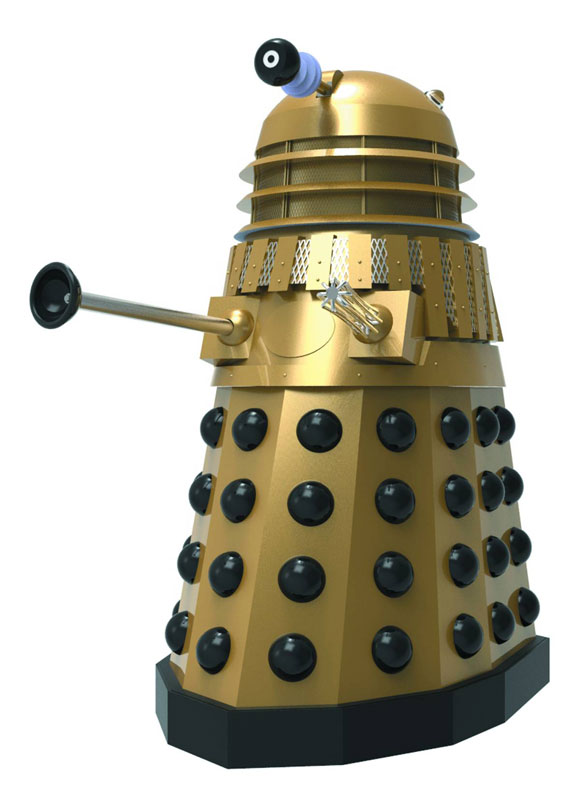
Glad I got that out of the way, and now onto the new episode, where we open with a big space battle against the Daleks. EXPOSITION- The Daleks are the Doctor's nemesis. Born from the radioactive ruin of the planet Skaro, they are deformed aliens that encased themselves in impenetrable armor, the design of which has not aged very well. They operate on the principle that peace is impossible unless they "Exterminate" all other life in the universe. This lead them into the aforementioned temporal war that destroyed the Doctor's people, which makes him hate them all the more. Imagine if Stephen Hawking had an invincible battle chair and Hitler's philosophies, that's a Dalek in a nutshell-END EXPOSITION.  Yeah, get used to that sort of thing, I have a feeling that it will come up pretty often with this show.

Anyways, we focus on one particular human craft as it becomes a casualty, but the pilot has been rescued by the Doctor. She is understandably horrified by the mysterious man that showed up as she died, and convinces him to take her back to base, on an asteroid. Where she and the Doctor are apprehended, and, upon hearing that there is a Doctor that just arrived, are taken to the base's one lone prisoner. A heavily damaged Dalek that is going on about how it must be destroyed, which peaks the Doctor's interest. After the intro, we cut to present day London, where Clara has just met a new co-worker, Danny. A veteran that, has no discernible character and doesn't really factor into the A-plot at all, so there is no reason to have him here. It doesn't really matter since soon after, the Doc arrives and we learn that from Clara's perspective, it's been three weeks since the end of the last episode.

He seems to have brought her on-board again to ask a question. "Am I a good man?" She responds that she really doesn't know. Understandable, he's literally a different person now, and it makes sense that the Doctor would have some concerns about that. It also makes sense that Clara, after not seeing him for three weeks, couldn't answer that question. It's a nice little moment that gets cut off because Doc decided to take her to the asteroid base. We learn that the Dalek is dying, and since it is uncharacteristically self hating, they want the Doctor to shrink himself ala The Fantastic Voyage and climb inside to see what's causing this. He is accompanied by some of the soldiers, which makes sense, and Clara, which doesn't.

There usually isn't that strong a reason for the Doctor to get involved in the problem of the week, but without it there wouldn't be a show half the time. However, here it makes even less sense. They already have suspicions that the Doctor is a Dalek spy, and now he disappeared and came back with a mysterious woman, how is he still trusted by them?

Anyways, Doc, Clara, and the soldiers all get put inside a pill, and enter via the Dalek's eye to get to it's brain, where they suspect the problem is. Once they're there, the Doctor goes on about the suppression systems meant to keep the Dalek angry, and how they seem to be on the fritz. After the soldiers start firing grappling hooks into it's brain for, no apparent reason now that I think about it, the Doctor freaks out about it since this activates the Dalek's internal security/immune system. (I'll never say this show is lacking creativity) It kills a couple of extras, and our heroes run down to it's digestive system, where they notice a surprising level of radiation. It turns out that the Dalek's fission reactor/heart is leaking, and that's probably what's gone wrong.

They go down to it's heart, and the Dalek starts talking to them. He starts talking to the Doctor about how it saw true beauty in the heat of battle. How it saw war, worlds being destroyed, but it also saw something else. It saw the birth of a star, a sort of light emerging from the darkness. That changed something inside the Dalek. It saw that no matter what, life would find a way. That "resistance" to that, a resistance that is the only reason he lives, is futile. That, is actually a clever and interesting inversion of that sci-fi cliche, which becomes irrelevant for a while since the Doctor fixes the radiation leak, and that immediately restores the Dalek to it's original programming/philosophy.

As fans of the show could have predicted, as soon as a time traveler helped a Dalek, it immediately goes on a killing spree across the base and calls for backup. Even a heavily damaged Dalek is pretty much unstoppable, which brings me to the older episode that this derives from, which looks to become a common thing with this season. In particular, the episode Dalek, which was also about a heavily battle damaged Dalek being helped by a time traveler and going on a killing spree through a heavily fortified base as a result. It is also my favorite episode of the show. It raises parallels between our hero and our villain, that, when things get serious, the Doctor is just as willing to resort to dirty measures as his enemy. An idea that is summed up by the line "YOU WOULD MAKE A GOOD DA-LEK!", said after he had been reduced to foaming rage and had started torturing the beast, because he hates them that much. Into the Dalek, feels like reheated leftovers of that episode. There isn't anything lesser about it, but time has dulled the flavor.

Anyways, Doc heads towards the brain as the soldiers pointlessly try to stop the Dalek's rampage, and since the soldiers received no characterization, most of them don't even have names, I felt uninvested in their struggle to the point that all I thought during the battle was "shouldn't the Doctor be regenerating after being so close to a fission reactor for so long? It's happened before." We're running out of time, so quickly, Doc gets to the Dalek's brain, sort of mind melds with it, and confronts it with the limitless wonder of creation that it had already discovered, successfully talking it out of it's rampage. It even convinces it's commanders to retreat, off screen, so there is no impact to this turn. Doc get's called a "GOOD DALEK!" in another callback to better episodes of the show, and Clara gets back to her irrelevant romance. The End.

I, don't have that much to say about this episode other than to say that is reheated leftovers of a better one. Peter Capaldi is still in top form, and he's loving this part. Jenna Coleman, while she has nothing to work with as Clara, comes off as a likable personality. Overall, this is an improvement over last week, but that ain't saying much. Next week, it seem's we're getting a period piece about the Robin Hood legend.

Have a nice day.

Greg.B

Sunday, August 24, 2014

TV Time: Doctor Who Recaps: Series 8 Episode 1, Deep Breath (TVPG - BBCAmerica - 1 hr, 19 mins)

SPOILER ALERT


Alo Party Peoples.

Written by Steven Moffat
Directed by Ben Wheatley
I realize that I need a better long term solution for slow release weeks than either taking stuff off of my DVD shelf or looking at premium on demand cable offerings (although that second one isn't bad), so I'd like to introduce the revival of something I had tried before. The new season of Doctor Who has just started, and for twelve weeks I will have something new to talk about regardless of what films have come out.

It is no secret that I wasn't impressed by the 50th anniversary episode Day of the Doctor, and I was in the minority there. I've already expressed my issues with it, so-so acting, excessive fanservice, too much focus on NuWho for what was supposed to be a celebration of the entire series, a climax and resolution that, in my opinion, undermined the title character's arc, and an odd lack of effort for something that the BBC was hyping up so much. If you want an actual celebration of fifty years of Doctor Who, I would recommend the docudrama about the franchise's beginnings that came out a day before the anniversary, An Adventure in Space and Time.

The subsequent Christmas special, The Time of the Doctor, was a fortunate improvement. It was a much better sendoff for Matt Smith's Doctor, and it had a sort of charm to it, even if it didn't quite fix the excessive fanservice problem of Day. In that episode, Smith's Doctor was granted a new set of extra lives by the Time Lords (more or less his old bosses) and subsequently became Scottish actor Peter Capaldi, who forgot how to fly his time machine to the horror of his passenger Clara.

We open, with a dinosaur tromping around Victorian London as Vastra, Jenny, and Strax (short version, the lesbian lizard woman from the age of dinosaurs, her human wife, and their alien butler, they're private investigators for some reason and writer/show-runner Steven Moffat loves shoehorning them into stories) watch. It coughs up the TARDIS (his time machine) and they head out to investigate. They come across a rambling Doctor and a horrified Clara. Twelve rambles at them for a while, faints, and then a not terrible but not especially good new intro sequence plays (that's the best version I could find). If I'm getting any vibe from this episode, it's that Twelve will be the Crazy Doctor, I'm not sure how I feel about that. On one hand, Capaldi fills that role exceptionally well. On the other hand, this Doctor scares me, and Clara.

From left to right, Christopher Eccleston (41 at casting),
David Tennant (34 at casting),
 and Matt Smith. (28 at casting, youngest Doctor ever)
 Notice anything about them? Here's a hint.
Peter Capaldi, at 56, is the oldest Doctor ever.
Anyways, after Twelve is crazy some more, Vastra gets him to sleep via an out of place cartoon-ish sound effect and psychic lizard powers that she suddenly has, and starts talking with Clara about why her friend suddenly has a new face. (short version, when the Doctor gets close to dying, he can renew his body but he loses his old identity in the process) Vastra then reprimands Clara for supposedly judging this new Doctor because he looks old. I can't help but think the intent here was to reprimand fans that had done that when Peter Capaldi's casting was announced, which I can get behind - what with Christopher Eccleston being my favorite Doctor - but I have two problems with this. 1) Most of those fans have probably only ever seen either David Tennant and/or Matt Smith in the part, not unlike Clara, and 2) I don't blame those fans or Clara for prejudging Capaldi/Twelve when the first thing this Doctor ever said to them/her was going on about his new kidneys, and informing them/her that he forgot how to fly his his time machine.

Later that night, the Doctor bolts awake, draws a bunch of stuff on the floor, runs across the rooftops of London to find the dinosaur, starts promising said dinosaur that he will bring it home, and it then bursts into flames before his eyes. Clara and the Paternoster Gang (fan lingo, how I will refer to Jenny, Vastra, and Strax collectively from this point forward) head to the corpse of the dinosaur looking for the Doctor. They find him and he's crazy at them some more while pointing to a man across the river Thames, which he then leaps into and swims away. (This character really is as crazy as my description makes him out to be) This man then reveals himself to be a cyborg and steals a passerby's eyes in plain view of all. Yes, it's night when this happens, but that won't hide the screaming. Cut to commercial.

The next day, Twelve starts digging through trash in the streets, monologues to a homeless man about his new face and the nature of regeneration, and presumably steals his coat. It turns out he was looking for newsprint and finds an article on spontaneous combustion, which serves as our transition to Vastra and Jenny discussing that topic while Jenny poses gratuitously for a portrait in what can only be described as pandering fan-service. There isn't even a story reason for this since Vastra wasn't painting her, she was working on a collage of newsprint about spontaneous combustion and a map pointing to a restaurant. Clara then walks in with a newspaper where the words "Impossible Girl" (something the old Doctor used to call her for reasons too convoluted to get into here, short answer, time travel) are opposite an advertisement for that same restaurant. Cut to commercial.

Later, presumably that afternoon, Clara heads to this restaurant and finds Twelve waiting for her. Now she's certain that he used his time machine to leave those words in the paper for her to find. They have some well acted banter, Doc calls Clara a needy and says she has a massive ego (dear god, this Doctor is a real jerk) and they notice something about the other customers at the restaurant. None of them have been breathing, they seem to run on clockwork. Then, like clockwork, a waiter arrives as they were about to leave and starts listing various useful organs. (this was reminding me of a vastly better Series 2 episode, The Girl in the Fireplace, that will be important later) It turns out they are the menu, and their booth restrains them before dropping them down into the basement where they will presumably be eaten. (You know, for kids!) Cut to commercial.


When we return, the Doctor and Clara have arrived in a chamber that appears to be the lair of the cyborg from earlier. Twelve pulls out the magic wand sonic screwdriver, and frees them. Twelve claims he's seen stuff like this before, and they start talking about the cyborg. Twelve notices that his hands do not match, and this leads him to say that it must be a "reverse cyborg", i.e. a machine giving itself organic implants rather than the other way around. Props for creativity there. Then the clockwork men start moving and our heroes decide to start running. Unfortunately, the door drops and traps Clara inside. The Doctor tells her to take the deep breath of the title to hide herself from the gear people. Even though he has the sonic screwdriver with him, which is more or less a magic wand by now, and he runs off. (Seriously, Twelve is a real jerk)

We now follow Clara as she walks awkwardly through the derelict vessel while holding her breath. Occasionally, the camera switches into first person from her perspective, and for some reason red flashes start appearing on the sides of the screen. At first I thought this was a transmission error, then I thought it was probably an attempt to visually depict oxygen deprivation. Eventually, she has to breathe and the gear people recapture her. Making this scene, sort of pointless. Cut to commercial.

When we return, Clara is being questioned by the Reverse Cyborg about where Twelve is, and she asks why they killed the dinosaur. Despite it insisting that they will not answer questions, it eventually says they did it for a part of the beast's optic nerve. Which means they've been on Earth long enough for them to know that a dinosaur would contain something useful to them. Remember when I mentioned a Series 2 episode earlier, that's coming into play now. That episode, The Girl in the Fireplace, involved a derelict starship which had a rather extreme self repair system run by clockwork robots. In the words of Tennant's Doctor in that episode "nobody ever told it the crew were off limits", these gear people are from the same fleet.

This makes no sense. In Fireplace, there was a reason for them to dismantle the crew, the ship was in deep space and stuck at sub-light speeds with very little chance of rescue, that ship was in a desperate situation and that called for desperate measures. The ship in today's topic on the other hand, is on a planet in an area with the capacity for mass production of various things. There is no reason for them to immediately resort to dismantling humans. Then again, maybe after apparently being on Earth since the age of dinosaurs, they're used to dismantling living creatures by now, I don't know.

Anyways. It then mentions a "promised land" that they have been trying to repair their ship to reach. Then Twelve pulls off a face he stole from one of the gear people for a disguise (they didn't hear him breathing?), and calls Clara a control freak for no apparent reason. Then the Paternoster Gang drop into the room in an unintentionally comic fashion for a brawl, and then, (what is it with this climax's pacing?), the restaurant, rises into the sky via, a hot air balloon made from human skin. (You know, for kids!) I, don't know if that's brilliant in an insane way, or just uncharacteristically morbid.

We need to wrap this up, so I'm just going to skim over the resolution. Clara and the Paternoster Gang hold their breath for a long time, Twelve is crazy at the Reverse Cyborg and claims that he is looking for a promised land as well (short version, lost home planet), he uses the argument that it has replaced every part of itself by now and is thus dead, and convinces it to commit suicide by jumping down and impaling itself on the roof of a church. (Again, Twelve is a real jerk) Clara is understandably horrified by this Doctor, she gets a phone call from the old Doctor telling her that Twelve needs her, she takes this at face value, and flies away with a madman. The End.

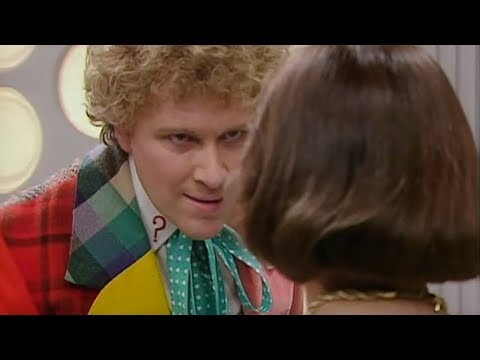
Pictured, the Sixth Doctor about to strangle his companion
What can I say about this episode that I didn't already say. I could list some good points. For one, Peter Capaldi is fantastic as the new Doctor, he's written to be a real prick, but he embodies that meanness well. If I have to compare him to any of the previous Doctors, I would choose Colin Baker, the Sixth Doctor. The one that was a complete jerk to his companion, possibly had severe bipolar disorder, strangled his companion in a fit of post regenerative rage, and came across as a madman with a magic box. (and all in his debut story) Don't mis-interpret me, Deep Breath not as bad an episode as The Twin Dilemma was, and Twelve gets physical with Clara, but he is verbally abusive to an extent.

That isn't meant as an insult to either one of them, but like Baker, Capaldi is a fanatastic actor that has to work with a bad script. One that has a glaring plot hole and where the new lead character comes off as a terrible person. I'm not left with good impressions for the season to come.


Have a nice day.

Greg.B

Friday, August 15, 2014

Let's Go Out To The Movies: The Giver (PG-13 - The Weinstein Company -1 hr, 34 mins)

Note- I realize that I didn't put out a review last week, that's my bad. The only big release, Teenage Mutant Ninja Turtles, was a foregone conclusion. We all saw it's advertisements, we all got the red flag of Micheal Bay handling another Gen-X nostalgia property, we all knew it would be terrible, and thus there was no reason for me to cover it. Word from the professionals is that it was even worse than it looked. Also, a spoiler warning is in effect.-End Note

Alo Party Peoples.

Directed by Philip Noyce
Written by Micheal Mitnick
and Robert B. Weide
The YA trend shows no sign of stopping soon in either the books it started in or the films that sprung out of it. Just this year we have, in order of release date; Divergent, The Fault In Our Stars, today's subject The Giver, The Maze Runner in September, and The Hunger Games: Mockingjay Part 1 in November. That's more than the superhero movie phenomenon, which has had only four major releases this year and attracts plenty of think pieces.

Today's subject, The Giver, is based on a 1993 novel by Lois Lowry that can be thought of as the progenitor of the whole phenomenon. The Hunger Games, Twilight, John Green's entire body of work, Harry Potter. The Giver predates all of it, and alongside Enders Game, it is the foundation on which countless subsequent YA authors would build, and by build I mean take the dystopian trappings of and endlessly rehash. Except Mr. Green, who's work tends to not involve the fantastic.

For those in my audience old enough to not have read it in middle school, The Giver the book is essentially 1984 mixed with Brave New World mixed with Fahrenheit 451 the kiddie version. Hum along if you know the words, in the future after an incredibly destructive and nondescript war, a dystopic society has emerged. In this version, state run planned Communities. Every aspect of people's lives is controlled by the Council of Elders, spouses are assigned to people based on a compatibility test, and children are assigned societal roles upon turning eighteen. The way that this dystopia maintains control of the people, rules and ignorance via a policy referred to as Sameness.

The people do not know pain or pleasure, see in monochrome due to genetic engineering, are of only one race, and emotional depth has been removed in exchange for social stability. Our nominal hero is Jonas, a child who is shocked to discover that he has not been assigned a job, but has been chosen to be the Receiver of Memory, a living backup drive of all the things that the Council has excised from the people's lives. He begins attending sessions with the old Reciever and slowly discovers that the world as he has always known it isn't quite right.

When reading the book for school, I always imagined that the Communities looked like a vague amalgam of mid to late 20th Century suburbia, the kind of place and atmosphere that Pleasantville was satirizing, but here it has been replaced by stock YA dystopia setting No. 23. However, I suppose that was inevitable, it was only greenlit to cash in on the success of The Hunger Games, and thus it feels and plays out like the other recent Hunger Games cash in, Divergent.

The film is incredibly fast paced, clocking in at only 94 minutes, and often to it's detriment. I know that part of what makes the written word a unique medium is that it allows you to really get inside a character's head without bogging down your story to do so, and that usually doesn't translate well to visual media, but scenes in The Giver the movie just come and go so quickly there isn't any real weight to them. Especially one scene in particular, which I will have to spoil here in order to explain my point, you have been warned.

SPOILERS BEYOND THIS POINT...


About a year into Jonas' training, and I'm not sure of that, it's paced so quickly, he discovers a certain truth about his Community. He discovers that part of the way that they removed difference from the general population is through a Spartan style eugenics policy of performing euthanasia on aberrant births. An example of aberrant births, the lighter of a pair of identical twins, having identical people would cause too much confusion. Jonas finds out about this when he watches his father, who is a nurse, performing this activity without a second thought. In Jonas' words "They didn't remove murder, they brought it home, they just gave it a different name." The obvious allegory aside - which I don't have a problem with in principle, you should be able to convey any message you want - in The Giver the book, this scene is haunting, it has an impact, I really stopped and thought after reading it, but in the movie version, it just comes and goes, like everything else.


END SPOILERS

The acting, which might have brought this up above average, is not very good. I don't know if the younger actors were told to deliver their dialogue like this, or if they're just bad, but they talk in a manner that no living human would ever speak. Maybe it was intentional to show how unnatural the policy of Sameness is, like the uncanny valley of social orders, but that doesn't give a pass for a bad performance. The older stars fare a bit better, Jeff Bridges as the old Receiver is fine, and Meryl Streep as the Chief Elder is, while not really developed, serviceable.

When I heard that a Giver movie was happening, I was naively hopeful. I thought that there was some serious potential in this material, and it could be genuinely great, but then I saw this teaser, and thought it would end up becoming an unintentional parody of itself and the YA phenomenon. Then again, it's adapting a work that kicked off this phenomenon, so maybe it was inevitable that when it was brought to the silver screen, not that much would stand out about it anymore. Lois Lowry, the author of the book, evidently stated that dystopian fiction is passe now, and I couldn't agree more. Fans of the book will find a paint by numbers adaptation that hits all the scenes and beats it needs to but brings nothing new to the table, everyone else will find the year's second big profile Hunger Games knock off, and are better off just renting Pleasantville.

Have a nice Day.

Greg.B

Sunday, August 3, 2014

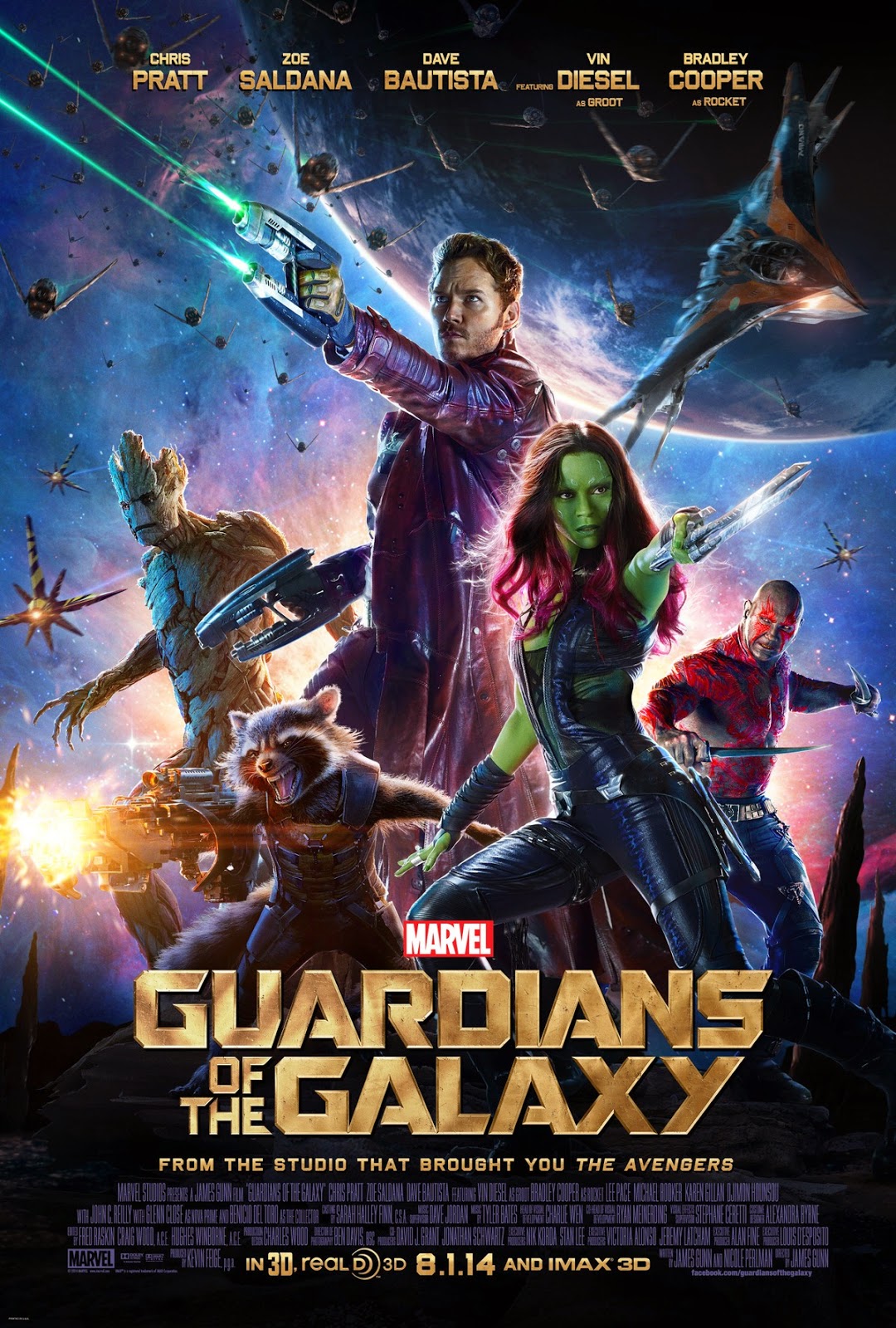
Let's Go Out To The Movies: Guardians of the Galaxy (PG-13 - Marvel/Disney - 2 hrs, 1 min)

Alo Party Peoples.
Directed by James Gunn
Written by James Gunn and Nicole Perlman

Each of the Marvel Cinematic Universe films has been a financial success, but while the idea of a live action comic style continuity spread across several disparate genres might seem to be an insane risk, or at least used to, each of it's component parts has had something to draw on as far as an audience is concerned, aside from comic fans that is.

Sure, Iron Man might have been a character that not many people outside of comics fandom had ever heard of, but the movie had Robert Downey Jr's star power to get people in seats. The Incredible Hulk had fans of the 70s' TV show, Captain America was known as a cartoonish symbol of wartime American patriotism, even Thor might have been known from Norse mythology if nothing else, and The Avengers had the novelty of seeing all those suddenly well known characters in the same movie together, and writer/director Joss Whedon's passionate following. A following that carried over to TV spin-off Agents of SHIELD, not for very long, but it was there when the pilot ran.*

Guardians of the Galaxy on the other hand, will be the first real test of whether the Marvel name alone is enough to fill a theater at this point. There aren't many name stars besides Vin Disel, who is never on screen, and maybe Chris Pratt, people usually don't see space operas in theaters unless they are named Star Wars or Trek, and the comic it's based on isn't very successful even by the standards of modern comic sales. It probably helps that it is opening basically unopposed, and that last week's action holdovers have had mixed word of mouth.

Anyways, our story concerns one Peter Quill, a man abducted by aliens as a child that has made himself into a Han Solo by way of Indiana Jones adventurer by the name of Star Lord. After he steals a particular magic rock, he finds himself the target of Ronan the Accuser, a villain that needs said artifact to destroy a planet that he has a grudge against. Quill is hunted by Ronan's assassin Gamora for the magic rock, and bounty hunters Rocket the space raccoon and Groot the tree man for a price on his head. They all end up being arrested and taken to prison where they meet Drax, a massive man with a grudge against Ronan. They decide to team up, escape, and sell the rock and split the money. Then they find it contains an Infinity Stone, an all powerful macguffin that explains why Ronan wanted it in the first place.

This is probably the most out there Marvel movie to date, abandoning the superhero sub genre entirely for a space opera in the mold of Star Wars or The Fifth Element. It accomplishes this very well courtesy of writer/director James Gunn, who I now want to handle a Star Wars picture somewhere down the line. The design of the various locations, starships, and devices are bursting with imagination, and it's easily some of the most original stuff I've seen on screen all year.

The cast is terrific, Chris Pratt does a fantastic job as Star Lord, perfectly embodying the archetype of a charismatic space outlaw. Dave Batista as Drax gives off a likable charm and his hyper literal affectation provides some of the film's funniest moments. The real standouts however, are Vin Disel and Bradley Cooper as Groot and Rocket respectively. They are, pardon the pun, marvels of voice work and motion capture, and it's amazing how much emotional attachment they get out of a raccoon and a tree man. Groot in particular becomes the emotional center of the film, Disel and the animators play him as a cross between a gentle giant and a loyal guard dog, and it is unbelievable how well this works. If there is a weak link among the main cast, it's Zoe Saldana as Gamora, but that's no fault of the actress, the script just doesn't give her much to work with.

Guardians of the Galaxy is the best kind of summer movie, putting likable characters in thrilling situations amid gorgeous 3-D justifying spectacle. It's the kind of stuff that usually doesn't come out anymore, and it's a welcome change of pace from the usual fare. Eventually, one of these things is going to not be up to snuff, but probably not for a while.

Have a nice day.

Greg.B


*Seriously though, SHIELD got a lot better after Winter Soldier came out. When it gets to DVD, just skip episodes 2 through 9 and you'll be fine.